The Shirehall Museum
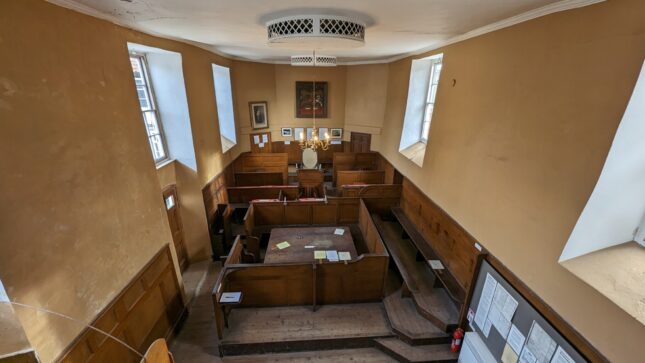
The Shirehall Museum in Common Place is accessed via the Abbey Grounds, with admission to the museum included with admission to Walsingham Abbey Grounds. Hidden inside you’ll find a complete unaltered Georgian courtroom as well as displays of local Walsingham history, and of the history of pilgrimage.

During the 18th and 19th centuries Walsingham was a thriving legal and administrative centre, with the Quarter and Petty Sessions held in the Shirehall in Common Place. Walsingham is very unusual in having both this Georgian Courthouse and also a Georgian prison, the House of Correction (or Bridewell).
The building has undergone many adaptations in its long life. It was most probably originally built in the early 16th century as a hostel for important visitors, perfectly positioned only 80 feet away from the priory church.
Originally it would have had two storeys with stained glass perpendicular windows in the upper storey and a fine open timber-framed roof (now concealed by the 18th century courtroom ceiling) to a great first floor hall.

In the 1770s a Georgian façade was added when the building was converted into the Shirehall for the Quarter Sessions (trials). These were held here from 1778 until 1861, and the Petty Sessions until 1974.
The Georgian Courtroom has survived unaltered since it was last used in the 1970s, complete with a lock-up cell where a defendant waits to come before the magistrate. It is now a hands-on museum where you can put yourself in the dock or play the judge.
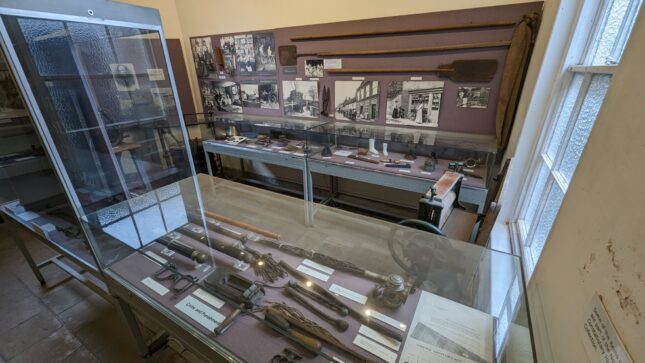
The museum has a comprehensive display on Walsingham as a place of pilgrimage, as well as local artefacts and photographs and displays on the history of village law and order.
The Bridewell
or House of Correction
Built in 1787, based on prison reformer John Howard’s plans for a Model Prison, the House of Correction stands on the site of the old Leper Hospital. The original building contained eight cells, including a special dark cell (used for punishment within the prison itself), a chapel and day room.
The prison was enlarged in 1822 when a further 16 cells were added. In 1823 five tread wheels were installed for grinding corn. These served as both exercise and punishment for the inmates.

After 1836 the prison was conducted on the silent system, a punishment that aimed to stop prisoners instructing each other in criminal activities.
The House of Correction was closed when the Quarter Sessions were moved from Walsingham in 1861. Following the closure, efforts were made to turn it into a roll-mill for grinding corn by steam driving the tread wheels, but this was not successful.
The prison has survived virtually untouched. It is open to the public — the key can be borrowed from Abbey Grounds entrance at the High Street Gate during opening hours.
For more information, visit the Walsingham Abbey website.